Note: Shading correction is a necessary procedure in order to ensure that you can acquire high quality images with your camera.
How does the shading correction function?
How often do you have to acquire new correction images?
See also
Working with shading correction
What is a shading correction?
Using shading correction, your software can remove image structures that originate in the imaging system and don't belong to the actual image information.
Without shading correction, the imaging system would cause image defects to be superimposed on the actual image information. When a shading correction is employed, these faults in the image will be determined and immediately corrected in the live-image.
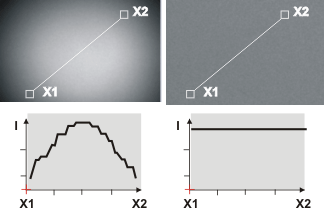
The left illustration shows an image where the shading correction has not been activated. The intensity decreases noticeably towards the edges of the image. In comparison to that, in the image on the right the shading correction has been activated.
This effect can be seen clearly in the intensity profile under the images. In the intensity profile the intensity was measured diagonally in the center of the image from point X1 to point X2. In the image with shading, the intensity drops off to the right and left. After the shading correction, the line profile is horizontal.
Online and offline shading correction
The term shading correction is mostly used to mean online shading correction, which automatically takes place during image acquisition.
Your software also offers offline shading correction. Use the Process > Enhancements > Shading Correction... command to correct the shading on an image that you already have. You will find more information on offline shading correction here.
How does the shading correction function?
To correct the shading in the live-image, you need two correction images; the dark current correction image and the flatfield correction image. Before you can use the shading correction, you have to acquire these correction images. Carry out the Shading Correction calibration process.
You can find step-by-step instructions on how to acquire the correction images here.
What exactly, is dark current correction?
The dark current correction image is an acquisition during which no light falls on the camera. The dark current correction is necessary to compensate for the dark current readout noise. The shading correction subtracts the dark current correction image from the acquired image.
Each camera has its own characteristic dark current correction image. Dark current correction images have to be acquired for every possible camera resolution.
The dark current correction image only changes very slightly. For this reason, you don't have to keep regularly acquiring the dark current correction image.
You can configure the shading correction so that a dark current correction can be carried out without a flatfield correction being carried out at the same time. When you carry out a flatfield correction, the dark current correction is always automatically included.
What is the flatfield correction?
The flatfield correction image is acquired with homogenous illumination and without a sample. The image shading correction divides the acquired image by the flatfield correction image and then norms it.
In addition to the camera characteristics, the microscope's characteristics, are incorporated in the flatfield correction images. In a transmission electron microscope, the imaging conditions change significantly in different magnification ranges. For example, different lenses can be used to achieve a lower magnification. You may require different correction images for the different magnification ranges.
The flatfield correction images depend on the transmission electron microscope's acceleration voltage. This means that when the acceleration voltage changes, you have to acquire a new flatfield correction image for the selected acceleration voltage. The flatfield correction images that have already been acquired are saved and can be used again later for the corresponding acceleration voltage.
You require flatfield correction images for every possible camera resolution.
How often do you have to acquire new correction images?
Acquire new flatfield correction images regularly. Otherwise the quality of the acquired images will get worse over time.
You should acquire new correction images in the following cases in particular.
•You change your transmission electron microscope's acceleration voltage. If no correction images have been acquired for this acceleration voltage yet, you get an error message when you try to acquire an image.
•You have changed the cathode.
•You haven't used the microscope for a long period of time.
•The microscope was readjusted during maintenance.
•The camera was unmounted and remounted.
00283 20032014